- personal travel notes (which works as an online
backup as well as an e-postcard to friends and relatives)

|

Monday, May 12, 2003
I had been made to understand that trekking in the Himalayas is a must when in Nepal.
It is apparently not only Nepal's tourist attraction Number One, it is a
kind of 'manhood test' or some kind of initiation ritual you simply
HAVE to go through in order to keep one's end up among the expats of Kathmandu.
And your
performance will be judged in meters above the sea level, if not in amount of blisters,
amount of times you vomited and got serious headaches because of altitude sickness,
amount of t-shirts you soaked with sweat, how much of a cold you got, how chapped your lips got,
how exhausted you were, how steep the climb was and how you were gasping for breath,
how dangerous and narrow the footpaths were,
how terribly strong and cold the wind was... and how f-a-n-t-a-s-t-i-c it was, in spite of all this
- not to mention when you HAD got through it and were
safely back in Kathmandu again.
|
So. Phhyiuh! I passed the "test". We came back to Kathmandu yesterday.
4,700 meters was as high as we got.
And yes, psysically it was just as tough as I had been warned about that it would be.
Don't get me wrong, though. It wasn't that I didn't wan't to go.
Envisioned to me by 'Tintin in Tibet', the Himalayas have fascinated me ever since I was
a young boy. "Their lofty peaks keep hidden many a mystery..." writes
the French anthropologist Michel Peissel in his account of a visit he paid to a
forbidden territory in the north of Nepal in 1964. His exciting and well-written book
which Marianne presented to me is entitled
'Mustang - a Lost Tibetan Kingdom' (republished by Book Faith India, 416 Express Tower,
Azadpur Commercial Complex, Delhi 110033, in 1992, ISBN 81-7303-008-1).
Peissel was the first Westerner to set foot in 'The Land of Lo' as the Tibetans call it
since a Swiss geologist, back in 1952, had
traveled with a caravan of yaks through the barren mountain valleys,
starting some 70 kilometers behind the
Annapurna range, beyond some of Nepal's greatest peaks. Mustang remains one of the last
close to autonomous Tibetan areas, ruled by a very old family of royals.
"The gods live there," Peissel wrote in 1964.
"Today, Mustang is no longer forbidden or forgotten, but you need a special
and rather expensive permit to go there. Only 10,000 tourists are granted one each
year, and it will take you a minimum of two to three months to obtain it," explains
the Nepali trekking agent as a reply to my question about the possibility of trekking
in Mustang.
In other words: forget Mustang, at least for this time around.
The Mount Everest range, then?
"It is rather crowded up there now," he answers. "In May this year, it is
exactly 50 years ago Edmund Hillary and Tenzing Norgay climbed the top of Mount Everest
for the first time. For this reason, 22 expeditions are linging up to repeat their
achievement. Apart from that, it is a rather demanding route, and the lodging facilities
aren't all that good. Trekking around Annapurna range would be the most recommendable,
I think. You could fly to Jomsom, for instance, and then start off from there."
I am sitting at the office of the trekking bureau
Highlander together with my host here
in Nepal, Marianne, and Monica, a Swedish doctor who is visiting Erika, another Dane working
here for the UN.
Marianne has arranged everything for me on beforehand, it appears. We meet with Monica and
Erika Sunday at noon, supposedly for lunch, and before long, Monica explains that she'd
love to go on a hike, but
she doesn't really feel like doing it alone. Maybe I'd like to join her?
Half an hour later we sit at this office - coincidentally
right next to the restaurant - and are given proposals for routes and prices. The shortest
possible trek takes six days, and we'll be walking right at the border of Mustang, the
'forgotten' kingdom.
"You will get to know muscles in your legs that you didn't even know you had,"
Marianne laughs, as I pull out my credit card and the trip is a reality.
I omit to tell her about my knee trouble.
We are told to buy rain coats and flash lights, and will be provided with a guide, sleeping bags,
a warm jacket, a trekking permit, and several others things needed.
|
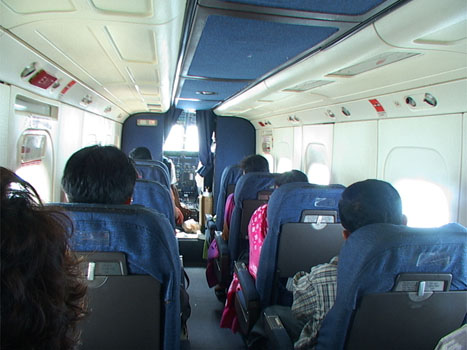 A couple of days later, we fly through the narrow passage between - and far below - the
gigantic peaks of Dhanlagiri and Annapurna, rising almost seven kilometers above the
villages in the valley, making it the deepest gorge in the whole world.
A couple of days later, we fly through the narrow passage between - and far below - the
gigantic peaks of Dhanlagiri and Annapurna, rising almost seven kilometers above the
villages in the valley, making it the deepest gorge in the whole world.
|
Stepping out of the little airplane, we are 2,710 meters above sea level, Monica reminds
me, and I should be aware of symptoms of altitude sickness. Not too bad: In Monica, I have
my own personal doctor along. And on Monica's side, she has along with her an enthusiastic
video photographer of her own.
 We have arrived in Jomsom, and feel as if a time machine had taken us 150 years back to
some obscure desert village of the Wild West in America.
We have arrived in Jomsom, and feel as if a time machine had taken us 150 years back to
some obscure desert village of the Wild West in America.
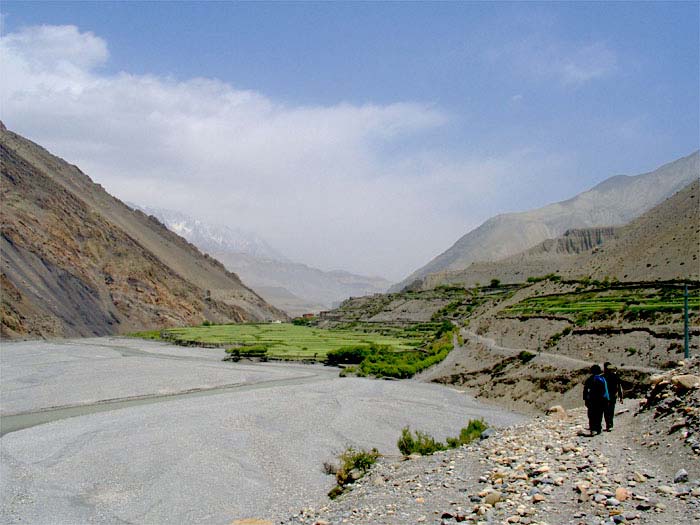
We grap our rucksacks and begin to head north along a grey, dried out river bed -
a lunar landscape of nothing but stones and rocks.
|
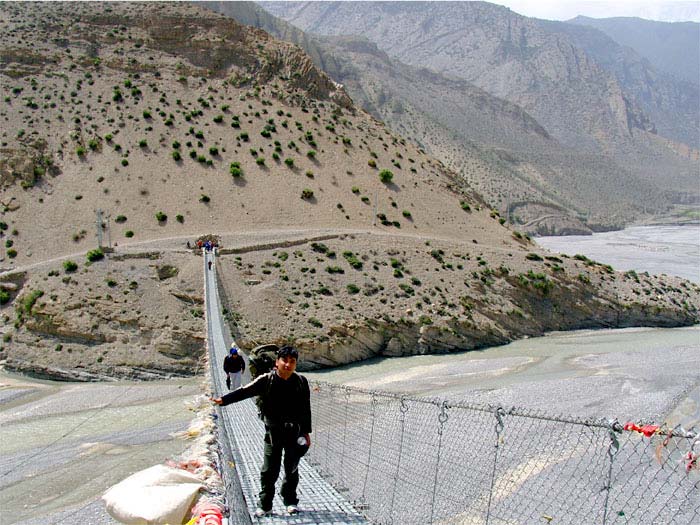
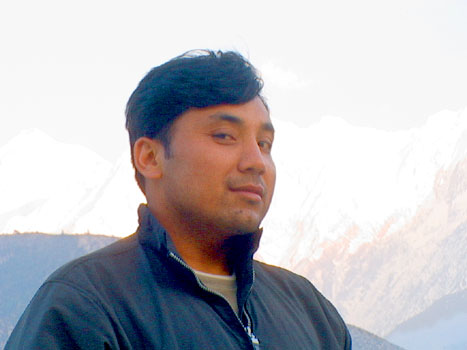 Our Nepali guide, 28-year old Raju Shrestha (who is studying for his masters in sociology
when he is not trekking with tourists like us) leads the way. He always answers in time -
in hours and days - not in distance, when we ask him how far it is from here to there.
Our Nepali guide, 28-year old Raju Shrestha (who is studying for his masters in sociology
when he is not trekking with tourists like us) leads the way. He always answers in time -
in hours and days - not in distance, when we ask him how far it is from here to there.
Generally, we walk something like five to six hours a day.
Raju turns out to be
a great asset to our trip, not only taking really well care of us and not only teaching
us a lot about the area and life conditions in these mountains, but
also about Nepali cultures, rituals and customs in general.
We really have a very pleasant time together, as a team, the three of us.
|
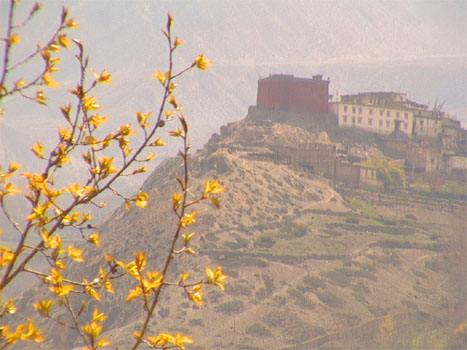
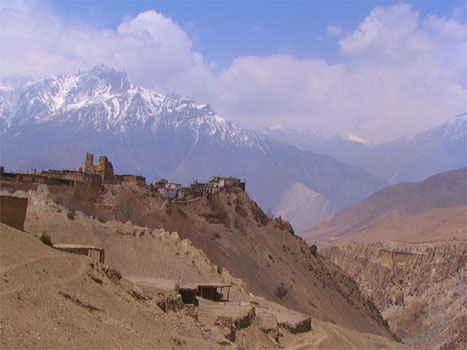 Midieval village: Jharkot
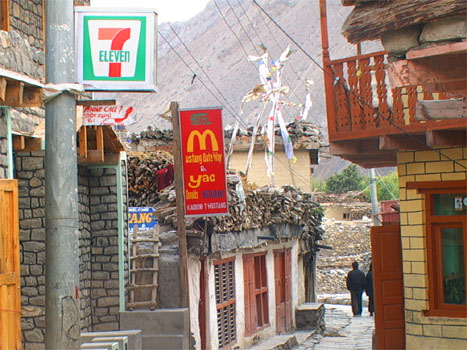 Most villages have a 'modern appendix' for the trekkers
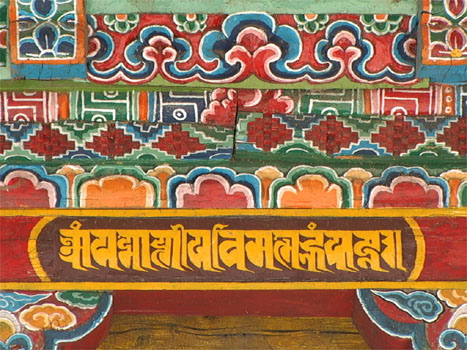
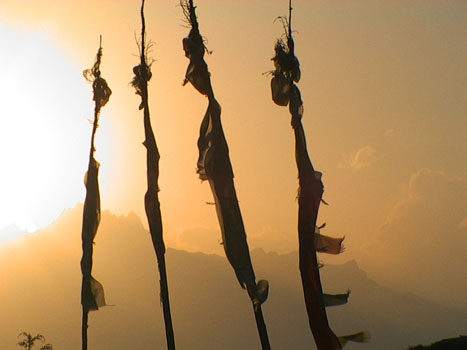 Everywhere you look, you see signs of spirituality


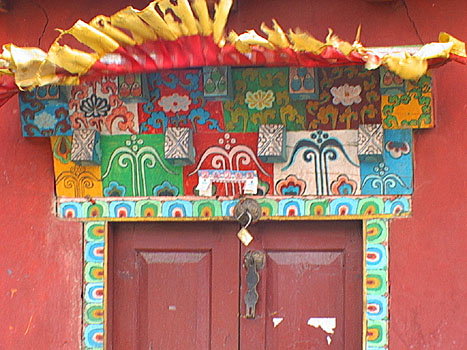
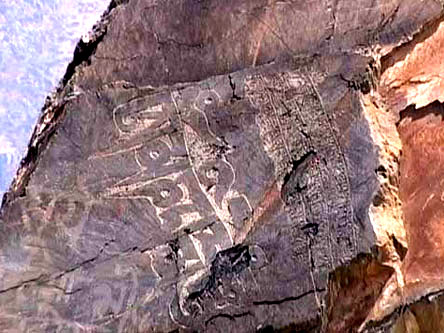
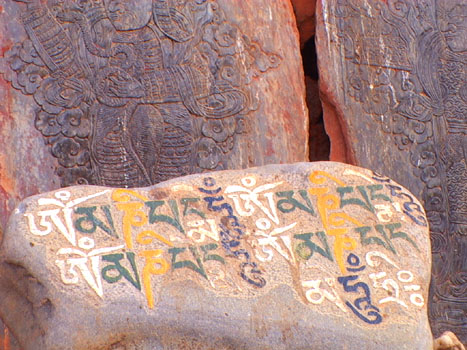
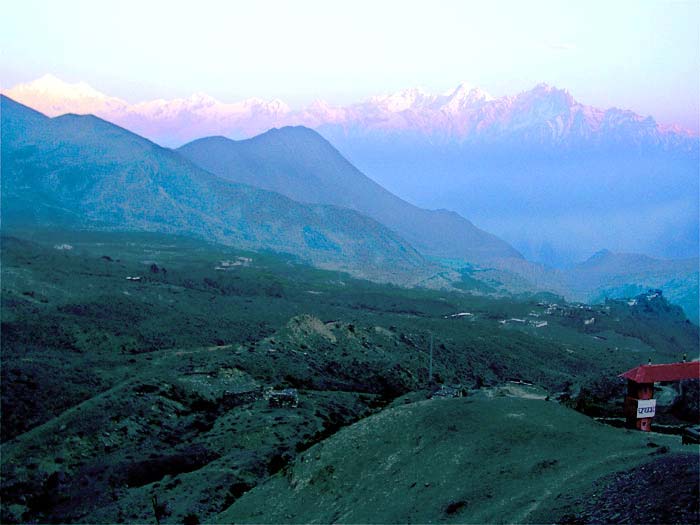
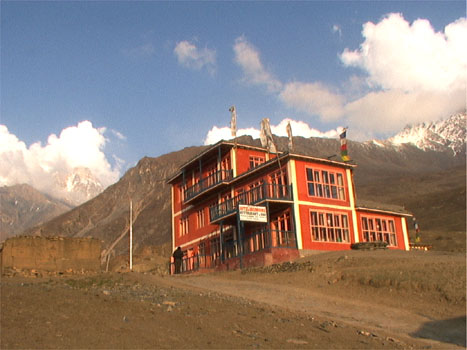 We spent two nights at Hotel Dream-home
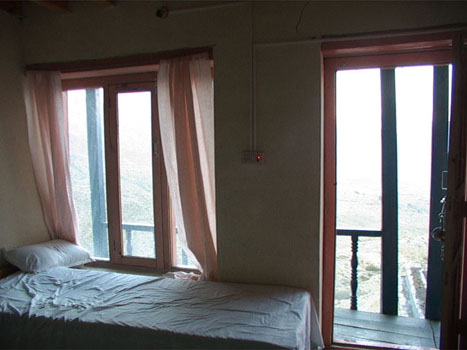 Room with a view...
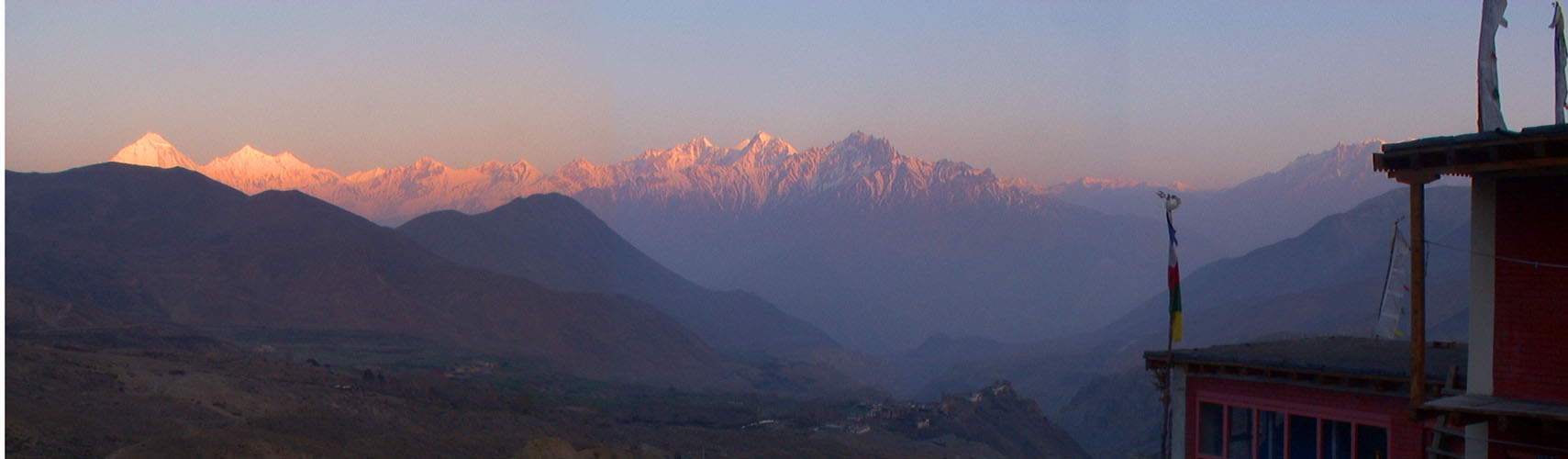
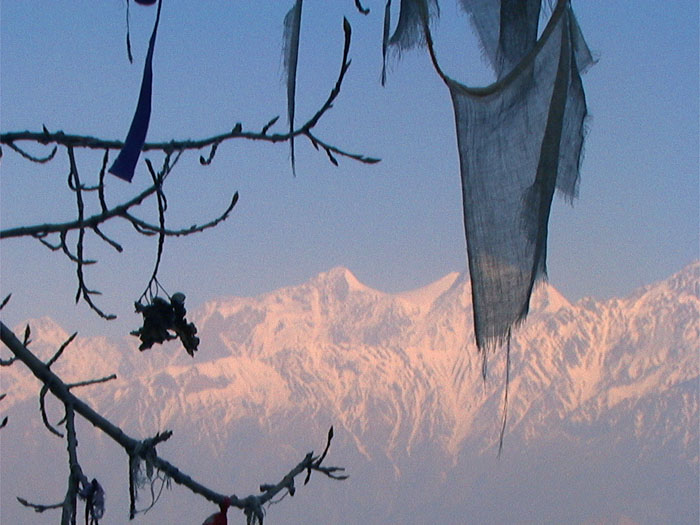
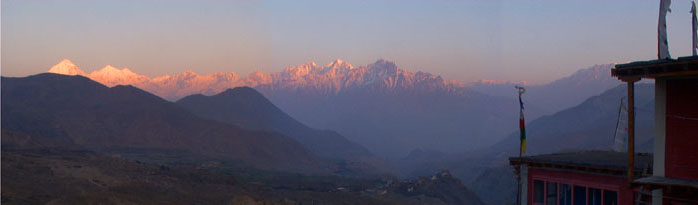 ...waking up to this. At 5:15, still lying under the warm downy feathers of
Marianne's sleeping bag, looking out of the window of my hotel room
at Hotel Dream-home. (Click on it to enlarge).
The peak at the very left is 8,167 meters high.
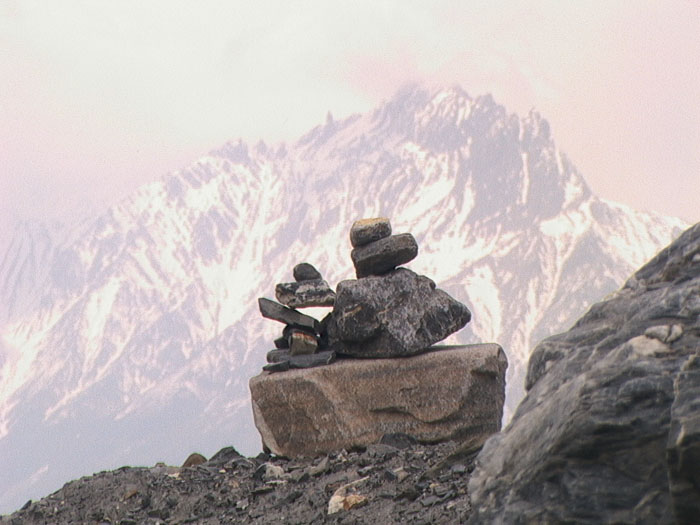
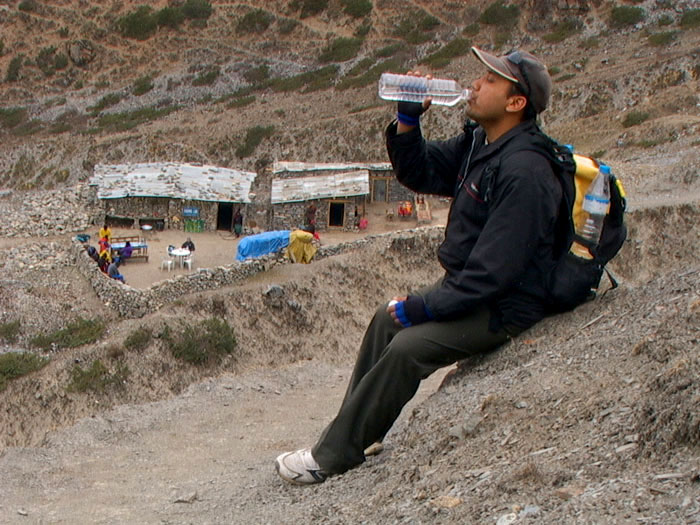 To your thighs and knees, it is the climbing-down-again part which
is the tough one
To your thighs and knees, it is the climbing-down-again part which
is the tough one
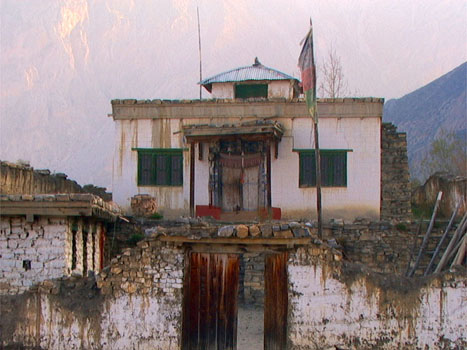 The destination of our trek is Muktinath, a temple which is the most holy place
to the hindus in Nepal, apart from the
Pashupatinath temple in Kathmandu valley. The destination of our trek is Muktinath, a temple which is the most holy place
to the hindus in Nepal, apart from the
Pashupatinath temple in Kathmandu valley.
Hindu pilgrims come to bath there in the spring water which tricles out from 108 outflows
shapes as cowheads. And buddhists come there to pray at a shrine where a blue flame
is burning over the creek, day and night. They arrive on foot there from as far away as
India. The few who can afford it fly up the 3,800 meters above sea level by helicopter.
|
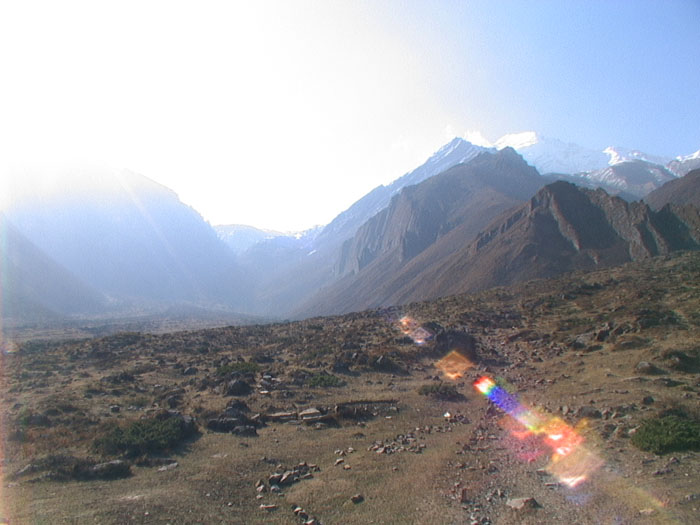
At a personal level, trekking in the hight of four kilometers above sea level is a depth psychological
into-yourself-and-out-of-the-body experience.
Send a person up to cross the Thorong Lha pass in 5,400 meters above sea lever,
and you will find out
who that person really is, deep inside. Layer by layer you will
be peeled off, right into the nucleus of your personality.
It is impposible to maintain any polite etiquette or keep up appearances while
gasping
for your breath at every single step you take forward, feeling like a 90-year old zombie,
soaked from sweat on the back, freezing your fingers and nose off, the straps of the rucksack
cutting into your shoulders, and so on...
Which was exactly how it was for Monica and I as well.
In short, this trip was just as harrowing and exhausting and at the same time as wonderful and
mind-blowing as Marianne had said it would be. As adventurous and spiritual as a
'mainstream tourist experience' could ever be.
|
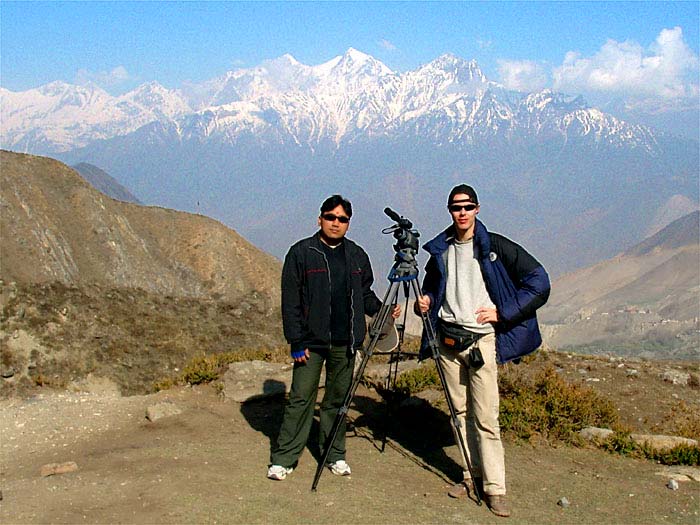
Carrying some seven or eight kilos of videocamera equipment
along gave extra strains, but will hopefully turn out to have been worth the
trouble. Took a LOT of nature shots for
Pernilla's forthcoming music video
|
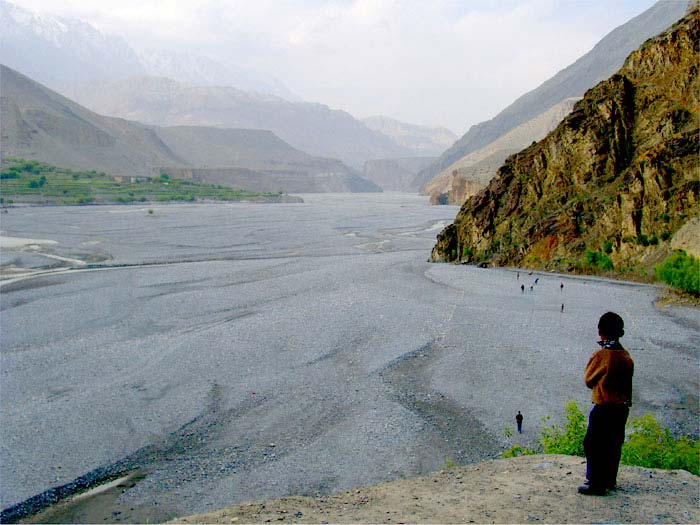 Back at the river bed
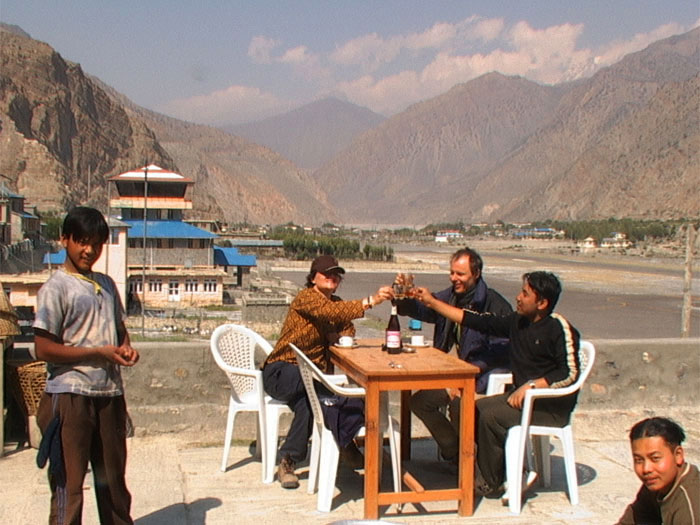 Celebrating and joking, back in Jomsom, after having done
the 20 kilometer stretch of the day in a strong, cold wind.
To sum up, this was our trek:
Celebrating and joking, back in Jomsom, after having done
the 20 kilometer stretch of the day in a strong, cold wind.
To sum up, this was our trek:
| DAY 1 |
Kathmandu – Pokhara
Six hours by car |
| DAY 2 |
Pokhara – Jomsom (2,713)
– Kagbeni (2,808)
The five day walk from Pokhara to Jomsom took us 35 minutes. Jomsom
to Kagbeni was 3.5 hours, approximately 10 kilometer |
| DAY 3 |
Kagbeni (2,808) – Muktinath
(3,802)
Approximately 10 kilometers, up-up-up. 4.5 hours. |
| DAY 4 |
Muktinath (3,802) – Thorung
Lha (almost, 4,700) – Muktinath (3,802)
Five kilometers upwards, and then back again. Six hours. |
| DAY 5 |
Muktinath (3,802) – Jomsom
(2,713)
18 kilometers, 6.5 hours, including a lunch break |
| DAY 6 |
Jomsom – Pokhara – Kathmandu
by air |
In other words, in two days we climbed 1,000 meters each
day, and all together we walked some 50 or 60 kilometers. (It sure felt
like more!)
Having tried this, I think a better route would be to fly to Manang
(3,351) and then walk over the Thorung Lha pass from there, and fly
back from Jomsom. The reason we didn't do that was because of our time
limit. The Manang–Jomsom trek will take eight days.
A little reminder to myself of what to remember for next
trek in Himalaya:
Flashlight. Suncream. Cap. Sunglasses. Extra trousers (inner trousers).
Skarf. Gloves. Rain coat. Head ache pills. Sleeping bag. Down feather
jacket.
Right now, Kathmandu is calling.
A whole programme has been set
up for me during my last four days here in Nepal. I have between three and four
appointments every day from now on, until I leave Nepal on Thursday.
Today, visiting the radio station Hits FM, and meeting with
Mr Chetan Karki, a veteran film director and lyricist. Tonight, we are going salsa dancing.
Tomorrow, among others, I'll
be interviewing the Secretary of Ministry of Culture and Tourism, Mrs R. B. Pradhan, and
later same day visiting the oldest English-speaking daily newspaper in Nepal,
The Rising Nepal. Plus more.
So, off to the bathroom for a shave.
ttyl.
posted by Mik Aidt at
07:42
|
|