– personal travel notes

|
| BACKGROUND
This is how I see Goa, after having travelled around on my first visit here in the month of January 2005.
I wrote this quick introduction to the place to some of my friends who'll be going here later this year.
|
| |
| GOA TRANCE
Goa is no longer that place of partying it used to be – the party has moved to Thailand, to places like Koh Pha Ngang, and to Ibiza. Rave parties on the beaches have been forbidden in Goa since 2000.
There are private parties, and nightclubs, here and there, though. The Sunday “afterparty” at Hill Top in Anjuna gathers around 300–500 people, and usually with good DJs.
Otherwise, check out the Nine-Bar near Vagator Beach, where they play music til 22 every night, and also the Temple near the southern end of Anjuna Beach.
In particular in the month of January, the party life of Goa is relatively dead.
|
| |
| CHARTER
In Denmark and Sweden, it is primarily the travel agent Apollo who has specialized in arranging charter flights to Goa.
WWW
goatourism.com
inside-goa.com
findall-goa.com
|
Goa for beginners
Goa is a state in India. To most Europeans, however, Goa is synonymous with a stretch of beach on the west coast of India. We are only talking about approximately 80 kilometers of coastline, so walking on foot the entire way from one end to the other could easily be done in just a few days.
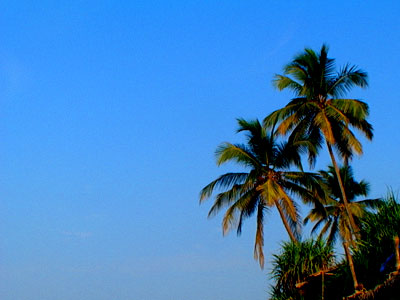
We spent 18 days in Goa in January 2005. In the first 17 days in a row, we enjoyed the look of a clear blue sky, and temperatures around 30–35 Celcius during the day. |
To cut it a bit rough, the Goan coastline can be divided in six zones, three in the north and three in the south.
Located right in the middle is the airport, and Panaji, the capital of Goa and the largest town in the state. Subsequently, the beaches near the airport are where the tourism industry is most developed, and this is where you find most of the one-week charter package tourists, as well as the most disturbing street sellers, swindlers and crooks, empty plastic bottles and garbage piling up.
 Some of the main beaches.
|
North of the airport the beach roughly can be divided in these three sections:
The northern charter tourism zone
Calangute and Baga once were two little Indian villages. Today, they have been covered and somehow merged together in a maize of unplanned roads and paths, decorated with garbage, pigs, cows, dogs, and charter hotels. The narrow beach is completely covered with beach beds for the tourists, and it doesn't have many palm trees.
Music in the restaurants is Lionel Richie's “Hello”, the Indian lounge/newage influenced Karunesh, and alike. Many of the restaurants are a very good standard.
The hippie (& trance) zone
North of Baga, a river and a steep rocky hill creates a borderline. If you cross that borderline by climbing the hill which is covered by rain forest, and continue walking north, after half an hour or so you will reach the southern beach of Anjuna.
You will instantly realise you have come to new territory. The music in the restaurants is louder, it is trance music, not pop, and the customers are wearing t-shirts with techno symbols, or colourful hippie outfits, or barely anything at all. This is what used to be the old party land of Goa, before the rave parties on the beaches were forbidden in 2000, this is where long rasta hair and maui tatoos are in majority, and where there are two famous flea markets every week, one at the beach of Anjuna every Wednesday, and another one inland every Saturday night.
The tranquil nature zone
North of Anjuna is again a hill with yet another old Portuguese fort, and yet another river which marks the next borderline. If you cross the bridge, a kilometer up the river, you find yourself in peaceful countryside with a few remote beach resorts, and some widespread, empty beaches.
This is the place to go when you just want “to get away from it all”, to breathe some fresh air and enjoy the nature as it looks around here. All the little animals on the beach are alive here, (whereas most seem to be dead of have disappeared in the package-tourist's areas).
Madrem Beach has a beautiful and recommendable high-end-but-low-price hotel, Madrem Beach Resort. The beach is so wide here that it feels like staying in a desert hotel.
One or two kilometers south of Madrem Beach you find Asvem Beach with several nice little bungalows scattered in-between the coconut palmtrees, (‘Little Goa’, ‘Golden Eagle’, ‘La Plage’ or ‘Paradise’, for instance), and nice cafes, such as the ‘Change Your Mind Café’ (which serves an excellent musli fruit salad with curd, and has bottles of honey on all tables).
These places are not mentioned in the guide books yet. What they say in the Lonely Planet Guide is: “It's a good place to get away from it all – while you still can.”
To me, this is the part of Goa which is worth visiting.
Okay, now quickly let's run through the beach-scene south of the airport too:
The southern charter tourism zone
The first beaches south of the airport are quite similar to Calangute in the north, only that the beach is somewhat more picturesque here.
The luxury zone
South of Benaulim is a stretch of beaches which are occupied with some of the most luxurious beach resorts of Goa.
A day at Leela (800 rupees) should be an extravaganza worth trying. (From 8,000 rupees and up for a room for a night there).
The ‘bountybar beach’ zone
At the very south of Goa you find a number of beaches which travel guide writers seem to agree are the most idyllic, romantic and charming beaches of Goa, with Palolem Beach being the main one. It is somewhat crowded, but crowded in a pleasant way. People here are into yoga and meditation, there are health food restaurants, lots of cyber cafés, and a relaxed and positive atmosphere.
The music played here at the restaurants is generally pop, except a few places who play lounge.
South of Palolem are a couple of very quiet and desolete beaches, Colomb and Patnem, where you can experience how Goa must have felt before the tourists moved in.
Conclusion
If you have only one or two weeks to spend in Goa, go directly to the ultimate north or the ultimate south of the state. All the rest is – in my opinion – a somewhat mixed experience, whereas Asvem and Mandrem Beach in the north, as well as the beaches around Palolem in the south, each have their own beauty and charm.
Also, it is worth considering to go a bit outside Goa, for instance down south to Gokarna which is an atmospheric temple city approximately one hour south of Goa. Around Gokarna there are some little ‘paradise beaches’, only accesible by foot, which have the ‘early Goa’ feel to them. More about Gokarna here.
Goa's tourism skisma
Goa is facing a number of problems with its many tourists. The environment is one, sex tourism another.
For instance, the largest circulated English daily of Goa, Herald, writes in its editorial on January 20:
“People of Goa cough on their way to work due to the pollution, stench of garbage and rotting fish. And people of Goa mourn the slow destruction of the habitat, which is having an impact on their lives. Will Goa become a big killing field?”
Three days earlier, on January 17, the socalled “S factor” (S for “sex, sleaze and sin”) in Goa's tourism was the topic of the Herald's editorial:
“Cases of paedophilia and attacks on foreigners are on the rise. (...) Well, let us be frank that tourism in Goa has reached a nadir contrary to what the authorities tout and what the tour operators try to spout. Local people find it difficult to go to the beach because they are crowded with Lamani's (the local word for “whites”) and beach beds. CRZ violations go on unabated and to add to the beautry the beaches are littered with garbage and sunken ships.”
In short, if you want to enjoy yourself as a tourist here, you have to be able to close your eyes to what is actually happening around you, and strictly focus on your own idea of relaxing and enjoying yourself.
Which, I guess, is exactly what the all the hundred thousands of tourists who visit Goa every year tend to do.
From Great Britain alone, 650 chartered flights land in the airport of Goa every year, and a good number of those charter-tourists end up in places such as Calangute because of its large number of inexpensive but relatively good hotels and restaurants.
North

Vagator Beach, north of Anjuna. |

Pretending to be a package-tourist on crowded Calangute Beach. |

Mandrem Beach: Basically, it feels as if you have it to yourself. |
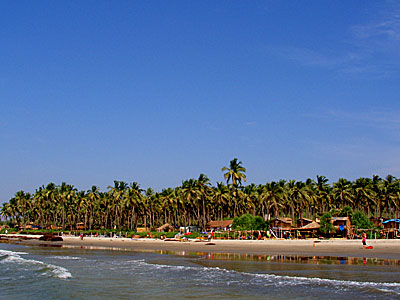
Asvem (also spelled Ashvem or Ashwem) Beach. |
>> More about Mandrem
South

Morning at Palolem Beach
|

Colomb Beach, south of Palolem. |
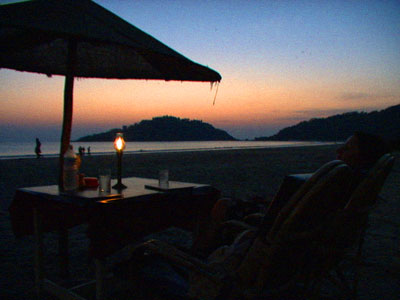
Romantic and delicious sea food dinners on Palolem Beach. |
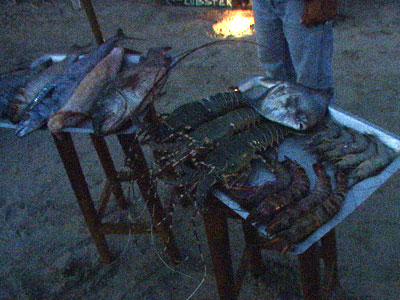
Difficult to make a choice! The price for a lobster or tiger prawn tandoori dish is approximately 10 US $ (300-400 rupees). |

The amount of internet cafés gives a hint on who are the inhabitants of a certain beach. In Palolem, for instance, there are lots of them, because this is where the young rucksack travellers like to stay. In the package-tourism areas such as Calangute, internet cafes are much harder to find. |
>> More about Palolem
posted by Mik Aidt on Jan 23, 2005, at 10:48
|
|
