– personal travel notes

|
BACKGROUND
A HOLY MOUNTAIN
“This mountain is itself Lord Shiva. That is nonother than Universal Self, and it is origin of the Universe. From here only the grace is transcanting to the devotees through the name and form on which they are meditating and worshipping,” explains Ramanadas to me.
“Even the sun and the moon cannot cross the peak of Arunachala. Whoever comes and rounds this hill, they wil get the grace of the Lord, and from that onwards the real journey to realise the self will start.”
Center of the universe or not, this certainly must be a mountain with a special vibration since – on special occations – it is able to gather up to 10 million people at its feet.
To understand what it means in an Indian context, you have to compare it to what the royal wedding of Mary and the Crown Prince meant to the Danes in spring 2004. Could you imagine 5,000 Danes gathering under the fullmoon and then walking around Himmelbjerget? This is what happens here, only that there are 200 times more people in this country.
“According to the scriptures of India, the hill is there earlier than the inception of the creation. It is the belief of Indians that the one who rounds the hill with a desire will be in success of that. But to be frank, the great people who knows Arunachala as Arunachala, used to say: “While rounding the hill, the which desire rises within us. Very naturally, the devotees will be in success of that without failing”,” Ramanadas tells us as we are taking a break from the walking.
|
| |
|
PRADAKSHINA
“To go around the Arunachala Mountain is good,” everyone is telling us.
The path – which since five years ago has become a paved road – is called ”Pradakshina”
Pra means removal of all sins
Da means fulfilling the desires
Kshi means freedom from future births
Na means giving deliverance through Jnana
We decide to go for it
|
| |
“Every prayer, mantra or invocation, no matter who or what it is directed towards – is ultimately an attempt to connect with the Universal Power – call it God Force if you wish – that pervades the whole of creation.”
Jacqueline Maria Longstaff
Jacqueline Maria Longstaff is a spiritual teacher from Denmark. She ran a travelling ashram, “Ashram of the Singing Heart” for seven years, for which a physical base has now been established in Tiruvannamalai, near Mount Arunachala.
|
| |
WHAT IS AN 'ASHRAM'?
There are many ashrams in India – all over the place, actually. You see the word spelled in many ways here. 'Asram', 'Asrama', 'Ashram', 'Asramam'...
Nevertheless, what these places all have in common is that they gather 'spiritual searchers', and often the place is guided by or run in memory of a certain guru, master or 'universal Mother'. As far as I am concerned, it resembles a monastery – with daily meditation and chanting, but it also functions as a sort of boarding school – with classes, lectures and teaching which often is highly philosophical rather than religious.
On the ashram, the inhabitants perform an ascetic “simple living high thinking”-kind of programme, and – in all cases I have heard of – refrain from alcohol, smoking and sex. |
The holy mountain Arunachala
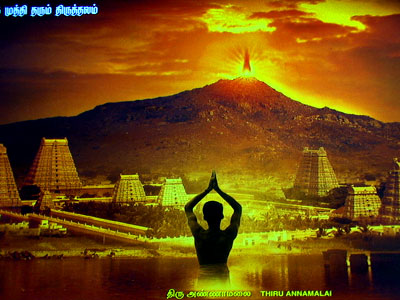
Mount Arunachala is believed to have a very special spiritual energy. Millions of Hindus make pilgrimage here every year. |
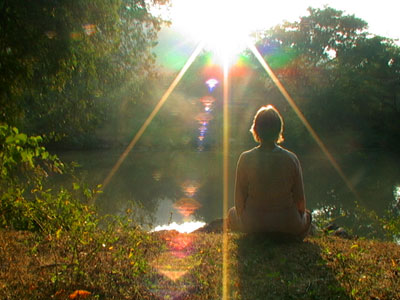
The area around the mountain is a place where people – including Padma, my traveling companion – come to meditate. |
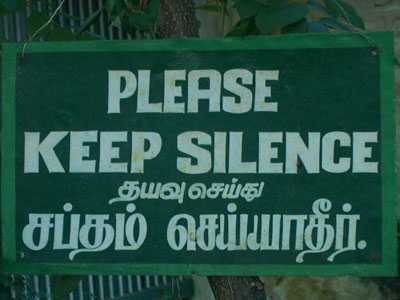
India, and probably in particular a temple city such as Tiruvannamalai, is full of sounds and music. Everywhere you hear loud or distant sounds of drums, flutes, singing, chanting, not to mention the roaring, beeping car traffic. But at many of the holy places absolute silence prevails. |
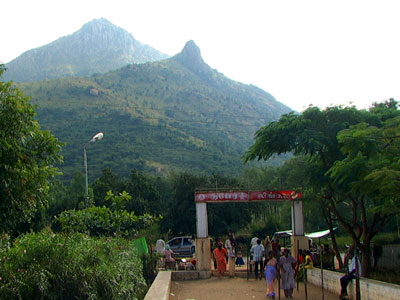
Somewhat similar to the way Muslims travel to Mekka to walk around a big, black stone, Hindus come from far away to walk the 14-kilometer route around Mount Arunachala, called Pradakshina. |
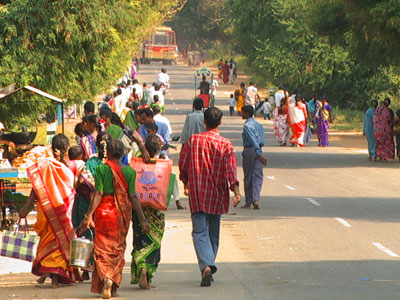
The walk must be done barefoot, in order to be in touch with and to honour the Earth, and “in a tempo as a pregnant queen”. Once a year, in November at full moon, one million Hindus gather at Tiruvannamalai, but also during the rest of the year, day and night, at any time, you see people doing the Prakdakshina walk.
|
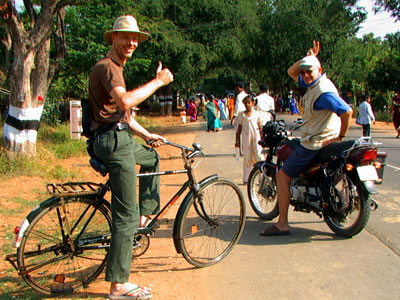
First day in India is "full on" mindblowing – zooming around on a bicycle through all these holy areas, with Jens as our guide. Glad I had some left-side-driving training in Australia!
At the end of the day, I feel as if I've experienced more than enough for a whole journey already.
Distant memories of yesterday's Copenhagen appear like if I had just been woken from a grey, zombie-like dream.
|
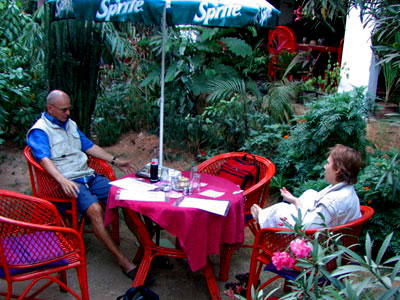
At dusk time, surrounded by hungry mosqitos, we take our first Indian supper at the Auro Usha Resturant. I'm having a delicious “Tomato Paneer Butter Fry” with green vegetable soup. |
Meanwhile, Jens Valmiki explains to me in brief about the “Shiva energy” of this area, and generally about what is going on around here, what he is doing himself here, and how he perceives it all. An invitation to get some interesting perspectives on what we have placed ourselves in the middle of here.
“What everyone is doing here, is looking for their way in to the nucleus. It is about transcending time and place,” he says.
“Similar to what Sokrates was saying some thousand years ago, “Know yourself”, what people are asking themselves around here is: “Who am I? Who am I? Who am I?”
When you keep circling around this question for quite a while, you might eventually figure out where your own nucleus, your own burning central issues are.” (“hvor det brænder for én selv”)
More about this topic...

The temples here are built in socalled concentric circles: you enter one room after the next, and go deeper and deeper in, until you reach the holiest place of them all, deep inside the center. And what do you find there? A mirror.
The Arunachala Temple in Tiruvannamalai has been there for a thousand years. |
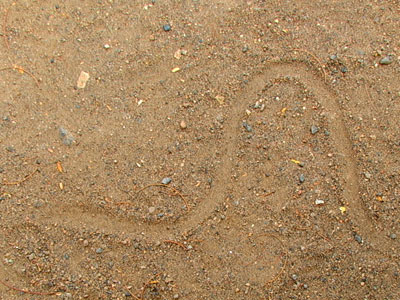
Jens Valmiki explains to us, using his finger in the sand: First was the straight line – then came this curve, the symbol of the Lingam. Many of the temples along the Pradakshina route are Lingams. |
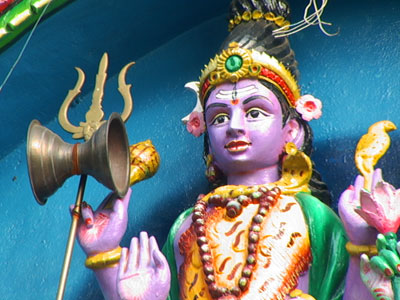
Shiva is the god of death and destruction, and plays the drum.
There are three main gods in Hindu religion.
Brahma is the god of creation and creativity (a god who no one seems to worship, don't ask me why!), and Vishnu is the god of maintenance.
Shiva is more attended to in the south of India, where as the northernes are more interested in Vishnu. |
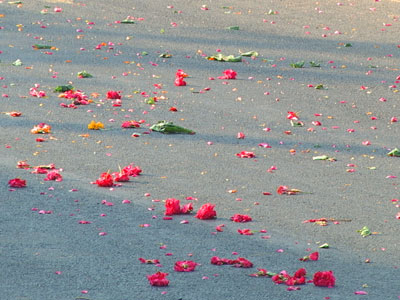
A funeral procession passes by, and people throw flowers everywhere. They are supposed to be run over by vehicles afterwards, symbolizing that "such is life”: “Today I shine. Tomorrow I am dead. Today I shine. Tomorrow I am dead.” (The lyrics of a song which the women sings). |
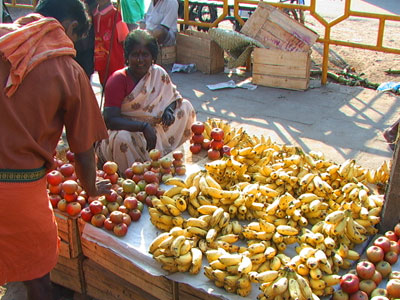
My main diet on day one: these wonderfully tasty bananas. 10 bananas for 10 rupees (app. DKK 1). |
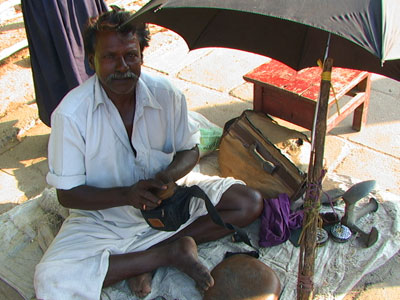
In ten minutes, a clever shoemaker fixes some major holes in my bag. |
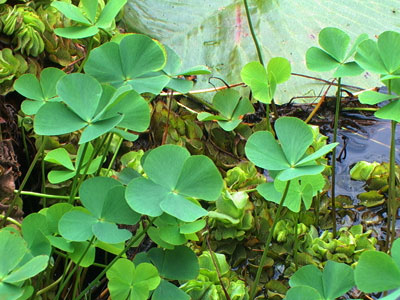
In Denmark, finding a plant like this one – with four leaves – brings you luck. Something tells me I'm a lucky fellow experiencing India. |
posted by Mik Aidt on Dec 17, 2004, at 09:13
We meet Ramanadas at night, in front of a cyber café. Nice guy! When he hears that we have been bicycling around the Arunachala Mountain, he makes it clear to us that this will not do. We need to walk on our two feet. He offers to guide us, and to explain to us about the places that we pass on the way.
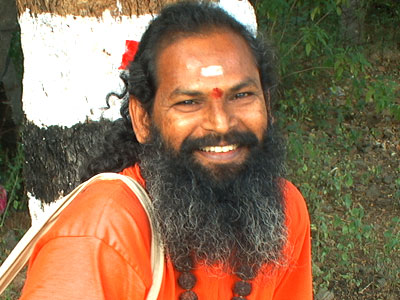
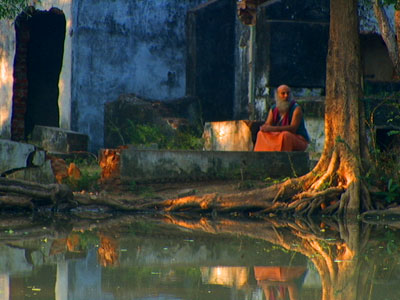
Ramanadas is a swami – a holy man. He left his job in a banking financial institution, as well as his family, to live alone on the mountain in a cave for four years, and, later on, three and a half years in a temple by the road.
Today, he is a “modern swami”, living in his own house. |
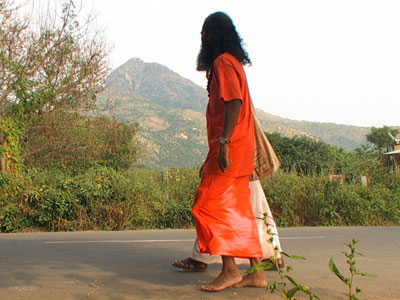
So... we agree to meet the next day, and at 14:30 when the sun is not so hot, we set off for the 14-kilometer hike, equipped with a bottle of water each, some almonds, and my camera. |
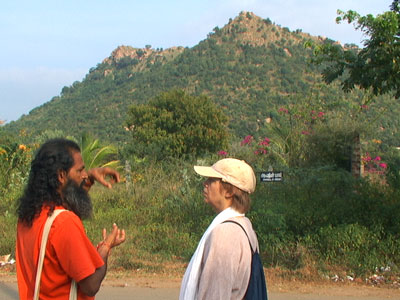
Ramanadas often talks of the human “tendencies” which stand in the way for enlightenment.
“Like the two little mountains become human illusion and cover the peak,” he explains at this point of the route, where the resemblance of two little hills to a woman's breasts become obvious. The peak in this case stands for “the God”. |

In particular the women are dressed in their finest clothes when they do the Pradakshina walk – as if they were going to a gala party. They all wear white or orange flowers in their long dark hair. |
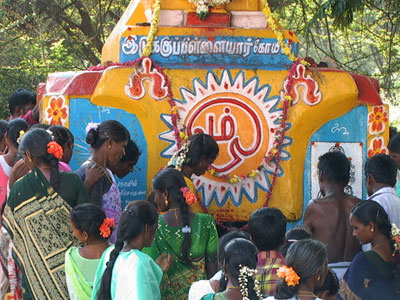
Dotted around the route are numerous “key points” – temples, shrines and holy places. |

Crawling through this narrow tunnel from front to back of the construction will give you liberation, whereas coming through from back to front will fulfill one wish, is the belief of the Indians.
|
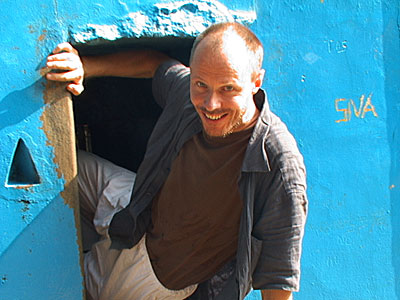
I make a wish and crawl through it from back to front... |

“Aum” in Tamil language. |
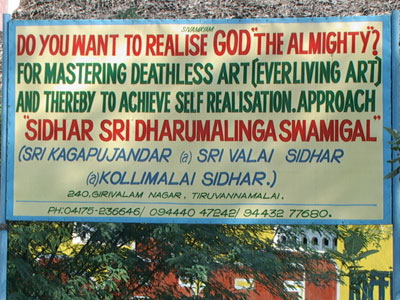
Because of the spiritual energy which the mountain is believed to posses, it is surrounded with numerous ashrams, meditation schools and spiritual colleges. |
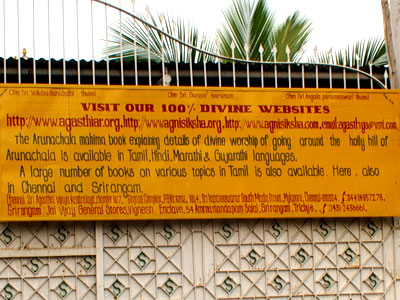
Even websites in this area are 100 percent divine. |

In Valmiki’s words: “Who am I? Who am I?” is the question which is being asked around here. Self knowledge is the issue.
“Arunachala – thou dost root out the ego of those who meditate on thee in the heart, Oh Arunachala,” it says on a bag we bought in a shop. |
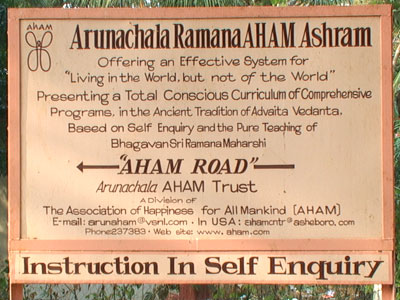
Sign showing how to find “the Association of Happiness for All Mankind”. (Nothing less!) |

Worshipping-spot for the devotees who visit Arunachala. |
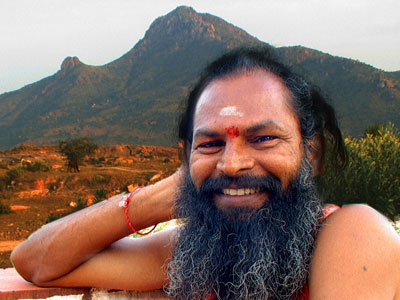
People around here seem to share the conviction that the inner reality has the same weight as the outer reality. Even the newspapers, such as Times of India, have sections with titles like “Mind over matter”, and long articles about yoga and self-discovery. |
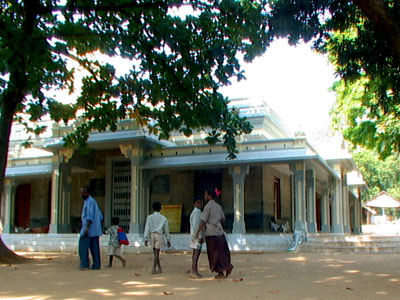
For four days (three nights) we stay at Sri Ramanasramam (“Ramana Ashram”) which was founded in the 1940ies by the guru Bhagavan Sri Ramama Maharshi. Somehow like living in a monastery. Though there is a steady programme of the day which most people follow, there are now strict rules about attending it. Everything is up to you. You are free to do use your time however you like, come and go whenever you please. |

A portrait of Bhagavan Sri Ramana Maharshi.
Sri Ramana is so to say “a Guru of the Gurus”. He lived in a cave on Arunachala Mountain, Shiva's Mountain, from 1899 and some 20 years onwards. He died in 1950, and has been – and still is – a great and highly praised inspiration to many many Indian gurus as well as lots of people in the Western world who come to live at the Ramana Asram in Tiruvannamalai, right at the foot of the mountain. |
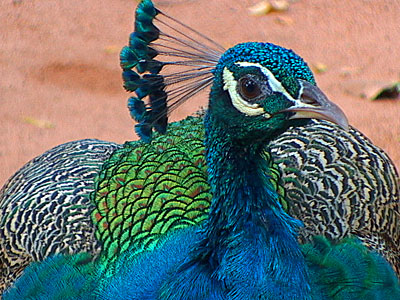
An inhabitant of the garden at the Ramana Ashram. |
posted by Mik Aidt on Dec 19, 2004, at 13:37
>> Climbing the Arunachala Mountain
|
|